Every patient at Bellissima BB Med Spa completes a Good Faith Exam before a single unit is drawn up. Most people assume this is a formality — a form, a signature, a box to tick before the interesting part. It is not. It is a medical evaluation, it is required, and its job is to establish that treatment is appropriate for you specifically.
Sometimes the answer is no, or not yet. That is worth understanding before you book, because a clinic that has never told a patient no is a clinic that is not really screening.
Botulinum toxin is a prescription medication. Prescription medications require a licensed provider to evaluate the patient, establish that the treatment is indicated, and take responsibility for the decision. The Good Faith Exam is that evaluation.
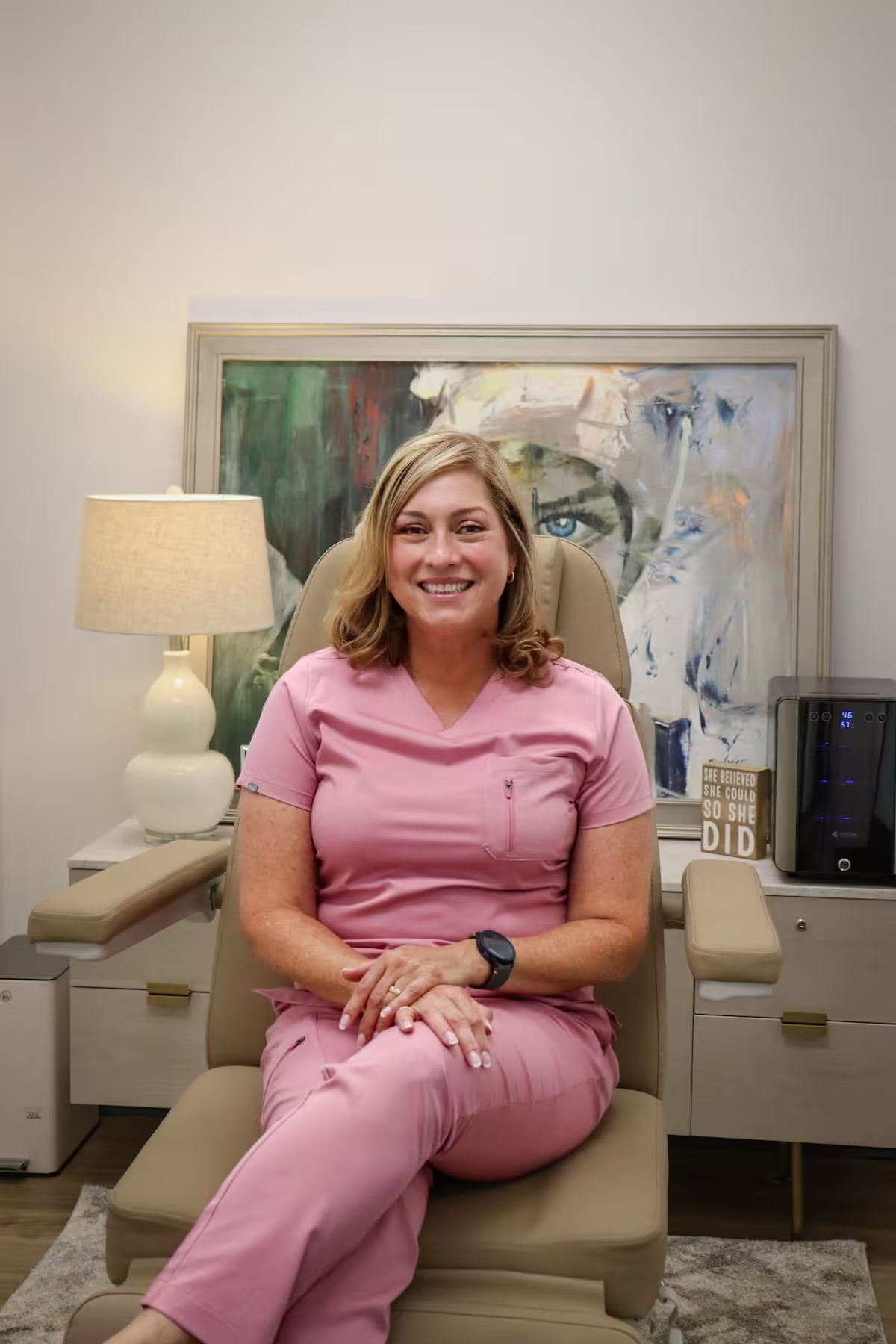
At Bellissima BB Med Spa in Frisco, TX, it is conducted by Carm, BSN, RN — a licensed registered nurse with more than thirty years of medical experience across emergency medicine, anesthesia recovery and surgical settings — working under physician oversight. It covers your medical history, your current medications, your prior experience with neuromodulators, and a direct assessment of the muscles being considered for treatment.
It is not a sales consultation. The questions are asked because the answers change the plan, and occasionally because they stop it.
Two situations rule out treatment outright, regardless of anything else.
A known hypersensitivity to botulinum toxin or to any component of the formulation. If you have had a hypersensitivity reaction to a previous treatment with any botulinum toxin product, that history follows you across products and it ends the conversation.
An infection at the proposed injection site. This one is temporary rather than permanent. Active infection in the area — including a significant breakout, cellulitis or a cold sore in the treatment zone — means we reschedule. Injecting through infected tissue risks spreading it, and the fix is simply waiting.
These are the two that appear in the product labeling as contraindications. Everything below is a matter of judgment, timing and additional caution rather than an automatic no.
Neuromodulators work at the junction between nerve and muscle. Conditions that already affect that junction — myasthenia gravis, Lambert-Eaton syndrome, ALS and related peripheral neuromuscular disorders — can make patients more sensitive to the effects of botulinum toxin, including effects beyond the injection site.
This is not a category we make judgment calls about in a med spa. If you have a diagnosed neuromuscular disorder, the decision belongs with your treating physician, and we will ask you to have that conversation before we proceed. A clinic that shrugs this off is not one you want holding the syringe.
Safety in pregnancy and breastfeeding has not been established. There is no scenario in which a cosmetic treatment justifies proceeding without that established safety, so the answer at Bellissima is simply no, and we will happily see you afterwards.
This is one of the more common reasons a patient's schedule gets interrupted, and it is worth planning around rather than working around. Treatment can resume when you and your physician are comfortable that it should.
Several medication classes are flagged in the labeling as potentially increasing the effect of botulinum toxin, and they come up more often than patients expect:
Nothing on that list is automatically disqualifying. What matters is that we know. Bring an accurate list, including supplements — fish oil, vitamin E and high-dose NSAIDs all thin the blood and all get left off medication lists because people do not think of them as medications.
And to be unambiguous: never stop a prescribed medication for a cosmetic appointment. If something needs pausing, that is a conversation with the physician who prescribed it. We will work around your medication, not the other way round.
Two timing questions come up in almost every exam.
When was your last neuromodulator treatment? The manufacturer notes that dosing more frequently than every three months has not been clinically evaluated, and shorter intervals are associated with a higher risk of developing antibodies to the toxin over time. If you were treated six weeks ago, the honest answer is usually to wait. Our guide to why Botox stops working explains why that interval matters more than it sounds like it should.
What else has been done to your face recently? Recent filler, laser treatments, microneedling, chemical peels or facial surgery all affect the plan — sometimes the timing, sometimes the placement. Facial surgery in particular changes anatomy, and anatomy is what dosing is built on.
Most declines are timing, not permanent exclusions. The common ones:
Separate from the question of who should not be treated, the product labeling carries a warning that applies to every patient and is worth reading rather than skimming: the effects of botulinum toxin can, rarely, spread beyond the injection site.
The symptoms associated with that are swallowing and breathing difficulties, generalised muscle weakness, hoarseness, trouble speaking, and loss of bladder control. They are rare, and in cosmetic use at cosmetic doses they are rarer still — the reported cases cluster around much larger therapeutic doses — but they are the reason we ask you to contact us and seek medical attention promptly if anything like that occurs after treatment, rather than waiting to see whether it passes.
The more ordinary risks are local and temporary: small bruises, brief redness or swelling at the injection sites, occasional headache in the first day or two, and — the one patients care about most — a temporary droop of the eyelid or brow if product migrates from where it was placed. That last one is largely a technique-and-aftercare issue, which is why the four-hour no-rubbing rule exists and why placement matters as much as dose.
None of this is meant to alarm. It is meant to be said out loud, because informed consent is not informed if the risks were never actually described.
The exam is only as good as the information it is built on, and patients routinely leave out details they assume are irrelevant.
And say what you actually want. "I want to look less tired" is a more useful brief than a list of products, because it lets us tell you honestly whether a neuromodulator is the thing that will get you there.
It is a conversation, not an interrogation, and it takes about ten to fifteen minutes for a new patient. Carm reviews your history and medications, asks what has and has not worked before, and then assesses the areas you want treated — asking you to frown, raise your brows and squint, because muscles at rest tell you very little.
That assessment is also where dosing is decided. Two patients whose foreheads look identical at rest can need meaningfully different doses once they move, which is why a number from a previous clinic is far less useful than your actual movement pattern. Our breakdown of how many units each area needs walks through that reasoning.
You will leave the exam knowing what is being treated, roughly what it will cost, what to expect over the following two weeks, and what the plan is after that. If something in your history means we are not treating today, you will leave knowing exactly why and what has to change.
Injectables have become routine enough that the medicine behind them is easy to forget. They are still prescription medications with real contraindications, real drug interactions and real consequences for getting the screening wrong.
Bellissima BB Med Spa is a private, one-on-one studio inside Mattison Avenue Salon Suites on Warren Parkway in Frisco, TX, serving patients from Frisco, Plano, McKinney, Prosper, Allen and North Dallas. Every treatment is performed by Carm herself — there is no rotating staff, and the person taking your history is the person holding the needle. If you are choosing a provider, our guide to what to look for in an injector covers the questions worth asking.
Book your consultation and bring your medication list. Even if the answer that day turns out to be "not yet," you will know why.
It is the medical evaluation required before a prescription treatment like botulinum toxin can be administered. It covers your medical history, medications, prior treatments and a direct assessment of the muscles being considered. At Bellissima it is performed by Carm, BSN, RN under physician oversight, and it is not optional.
The labeled contraindications are a known hypersensitivity to botulinum toxin or any component of the formulation, and an active infection at the proposed injection site. Beyond those, pregnancy and breastfeeding are a no because safety has not been established, and diagnosed neuromuscular disorders require your treating physician's input rather than a med spa's judgment.
Never stop a prescribed medication for a cosmetic appointment — that decision belongs to the physician who prescribed it. What matters is disclosure. Blood thinners and antiplatelet medications increase bruising rather than blocking treatment, and knowing about them lets us plan timing around your events.
It depends entirely on the condition, and it is a question for your treating physician rather than one a med spa should answer on its own. Conditions affecting the nerve-muscle junction specifically call for extra caution. Bring the diagnosis and any specialist guidance to your Good Faith Exam.
You will be told why, and what would need to change. Most declines are about timing — too soon after a previous treatment, an event too close, an active infection or illness — rather than permanent exclusions, and in most cases there is a clear date when treatment becomes appropriate.
They overlap but are not identical. A consultation discusses goals and options; the Good Faith Exam is the medical evaluation that establishes treatment is appropriate for you. At Bellissima both happen in the same appointment, before any treatment is performed.