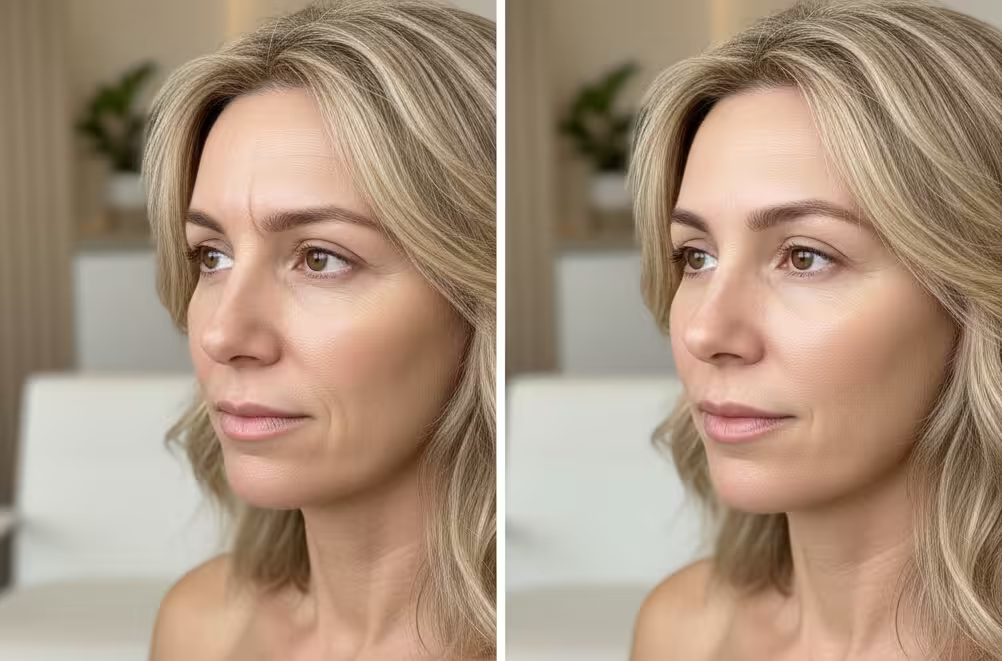
The most common confusion patients walk into a Frisco, TX consultation with is whether they need Botox or filler. The two are often grouped together as injectables, share an exam room, and get talked about in the same Instagram reels — but they do completely different things. Botox softens muscle activity. Filler restores or adds volume. Confusing one for the other is the most frequent reason patients leave their first injectable appointment underwhelmed. At Bellissima BB Med Spa, Carm, BSN, RN spends real consultation time helping patients understand which problem they are actually trying to solve before any product enters the conversation. This guide breaks down the difference plainly, walks through where each treatment is genuinely useful, and explains how to think about the decision for your face.
Patients across Frisco, McKinney, Plano, Allen, and the broader North Dallas area book consultations all the time asking for Botox in the cheeks or filler in the forehead — neither of which is the right tool for the job. The fix starts with understanding the basic mechanism of each.
Botox is a neuromodulator. It temporarily reduces signal transmission from nerve to muscle in the targeted area. The muscle relaxes, dynamic wrinkles soften, and lines that form when you make expressions become less visible. Botox does not add anything to your face — it changes how an existing structure behaves.
Filler is a volumizer. It physically deposits hyaluronic acid (in most modern fillers) under the skin to restore lost volume, contour features, smooth static lines, or enhance specific areas. Filler does not change how your muscles move — it changes the underlying structure those muscles move over.
Once you understand that difference, the right tool for any given concern usually becomes obvious. The American Academy of Dermatology's overview of dermal fillers reinforces this functional separation, and the American Society for Dermatologic Surgery's soft tissue filler resource details the categories of fillers and their typical uses.
Botox is the right answer when the wrinkle or concern is caused by repeated muscle movement. The classic indicators:
Filling these areas with hyaluronic acid will not solve the problem because the issue is not volume — it is the muscle creating the line every time you make the expression. Adding filler to a hyperactive muscle area can actually look worse, because the bulk emphasizes movement rather than dampening it.
Filler is the right answer when the concern is caused by volume loss, asymmetry, or static contour. The classic indicators:
Botox cannot fix any of the above because Botox does not add volume. Treating volume loss with neuromodulators alone is the most common reason patients say they tried Botox and felt it did not work — they were treating the wrong problem with the wrong tool.
The most useful way to think about Botox versus filler is on a treatment-by-treatment basis. Here is how the most common concerns map:
Some areas benefit from a combination. Lips are the cleanest example: filler adds volume, Botox softens the surrounding muscle activity, and the two together produce a more balanced result than either alone.
The four most frequent confusions Carm sees during consultations:
An honest injector tells you when the product you are asking for is not the right answer for your face. That is one of the most important markers of a credentialed practice.
Bellissima BB Med Spa is an injectable boutique focused specifically on Botox, Xeomin, and Daxxify. Carm chose to specialize in neuromodulators rather than offer filler because mastering one category of injectables — the dosing, the anatomy, the long-term planning — produces consistently better results than spreading attention across many treatment types.
What that means for you: if your concern is muscle-driven (any of the Botox indications above), Bellissima is the practice. If your concern is volume-driven (filler indications), Carm will be honest about that during consultation and can recommend reputable filler-focused practices in the Frisco and North Dallas area. Many patients build their care across two providers — one for neuromodulators, one for filler — because that produces the best outcome at each treatment type.
You can read more about Carm's clinical philosophy and the rationale for the boutique focus.
Use this simple test the next time you are looking in the mirror trying to decide what you want addressed:
This is the same evaluation Carm walks through during consultation, but with the benefit of years of clinical experience and the ability to assess movement patterns you may not see in your own face. The American Society of Plastic Surgeons offers a useful side-by-side overview for additional context.
For patients who eventually need both, the standard approach is to start with Botox to address muscle activity, observe how the face looks at rest after Botox is fully settled (around two weeks), and then evaluate whether filler is still needed for static volume concerns. Many patients find that softening the dynamic component with Botox makes them less interested in filler than they originally thought.
For patients on a maintenance plan, the cadence usually settles into Botox every three to four months (or Daxxify every six to nine months) with filler refreshed annually or every 18 months as needed. The Bellissima Beauty Membership covers the neuromodulator side of that plan with priority booking and predictable scheduling.
The right starting point is an honest consultation. Carm walks through your aesthetic goals, evaluates which concerns are dynamic versus static, and either maps a Botox-only plan or recommends a combination approach with a trusted filler provider for the volume side.
Bellissima BB Med Spa
Mattison Salon Suites & Spa
7777 Warren Pkwy #200, Suite 122
Frisco, TX 75034
Phone: (214) 392-9897
Book a Frisco consultation to figure out the right tool for your face. Or browse the rest of our injectables blog for more context on individual treatments.
For some patients, yes — if your only concerns are dynamic lines from muscle movement. Most patients eventually find they want both for different concerns, but starting with Botox is often the right first step. Once Botox is settled, you can re-evaluate whether filler is needed.
Both treatments are safe when administered by a credentialed medical professional with proper training. Filler carries different risks than Botox — vascular complications are rare but more serious if they occur — which is why injector experience and anatomical training matter even more for filler than for neuromodulators.
Carm chose to specialize in neuromodulators rather than offer multiple injectable categories. Specialization produces more consistent results than generalist practice. Patients who need filler can be referred to reputable filler-focused providers in the Frisco area.
Make the expression that creates the line, then relax your face completely. If the line disappears when you relax, it is dynamic and Botox is the answer. If the line remains visible at rest, there is a static component that filler may help address.
At a combination practice, yes. Bellissima focuses only on Botox, Xeomin, and Daxxify, so filler would be a separate appointment with another provider. Many patients prefer this two-provider approach because each specialist focuses on what they do best.
Most hyaluronic acid fillers last 6 to 18 months depending on the product and area. Botox lasts 3 to 4 months; Daxxify often 6 to 9 months. The treatment cadence is different for each, which factors into long-term planning and budgeting.
No. Each addresses a different problem. The only thing that reverses filler is hyaluronidase (an enzyme that dissolves hyaluronic acid filler). Botox simply wears off as the body metabolizes it.