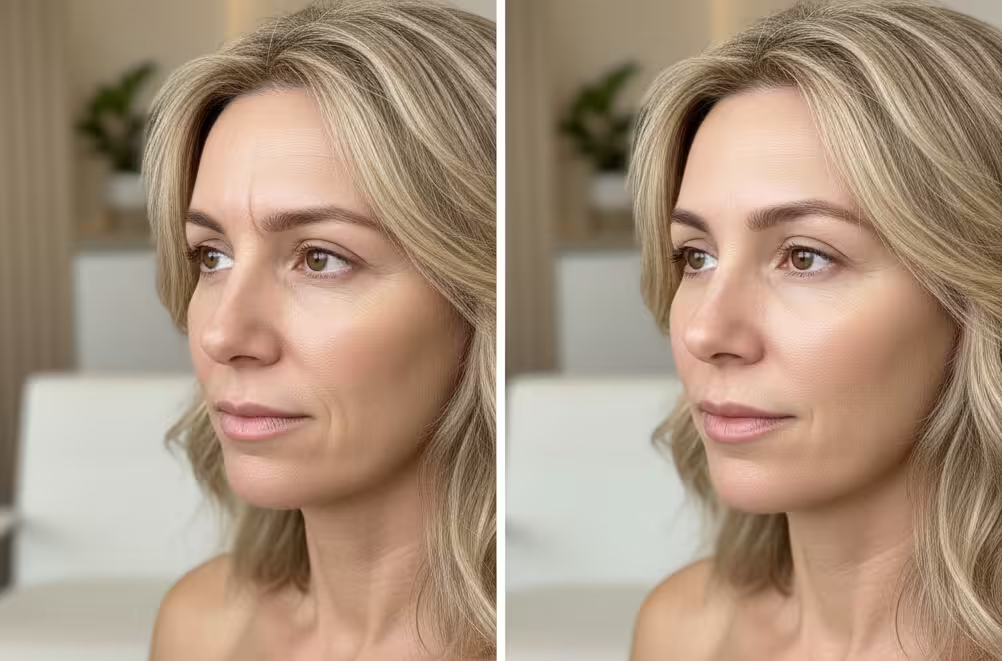
The lines that fan out from the outer corners of the eyes are the only facial lines most people are genuinely ambivalent about. They appear when you smile, they are associated with warmth, and a face without any of them at all can read as slightly wrong. Which is exactly why crow's feet are the area where over-treatment is most obvious and most regretted.
Getting them right is a question of restraint, not strength. Here is how the area actually works, what treatment can and cannot do, and how Carm, BSN, RN approaches it at Bellissima BB Med Spa in Frisco, TX.
The muscle responsible is the orbicularis oculi — a ring of muscle encircling the eye. Its lateral portion, the part sitting at the outer corner, contracts every time you squint, laugh or shield your eyes from the sun. Each contraction folds the very thin skin over it, and over years those folds become visible even at rest.
Two things make this area different from the forehead. The skin here is among the thinnest on the body, so it creases earlier and shows the effect of sun exposure sooner. And the muscle is comparatively delicate, sitting close to the surface, which means the doses involved are smaller and the placement is less forgiving.
The clinical name is lateral canthal lines, and it is worth knowing because it is what the labeling and the research use.
This is the single most useful distinction to understand before treatment.
Dynamic lines appear when the muscle contracts and vanish when your face is still. These respond well. Quieting the muscle stops the fold from forming, and the lines soften substantially.
Static lines are visible at rest, with your face completely relaxed. They are creases in the skin itself, produced by years of folding plus sun damage that has degraded the collagen and elastin holding the skin taut. A neuromodulator will improve them, sometimes noticeably, but it will not erase them — because the problem is no longer only muscular.
Look in a mirror with a completely still face. Whatever you can see there is the part that will improve partially rather than fully. This is not a limitation of dose or product, and no injector can dose their way past it. It is also why patients who start treatment earlier tend to have better long-term outcomes: prevent the fold and you slow the etching. Our guide to preventative Botox in your 20s and 30s covers that logic in full.
The FDA-approved dose for lateral canthal lines is 24 units total — 4 units at each of three sites per side, six injection points across both eyes, placed into the lateral orbicularis oculi. That is the reference point, not a prescription: it is where a standard treatment starts, and your dose is adjusted from your anatomy.
What moves it up or down is muscle strength and the extent of the fanning pattern. Some people have a compact set of lines confined to the outer corner; others have a broad fan extending toward the temple and down onto the upper cheek. Broad patterns need more injection points, not necessarily more product per point.
Units are also product-specific. If you are considering Xeomin, its units are explicitly not interchangeable with any other product's, so a number carried over from a previous clinic tells you very little. Our breakdown of how many units each area needs explains how the assessment actually works.
The orbicularis oculi sits next to muscles that do jobs you very much want left alone, and the margin for error is small.
Injections placed too far medially — too close to the eye — risk affecting the muscles that control the eyelid. Placed too low, they can influence the muscles involved in the smile, producing an oddly flattened cheek movement. Both are the classic signatures of an over-eager crow's feet treatment, and both resolve on their own, but they take the full three to four months to do it.
The safe zone is lateral: outside the bony orbital rim, in the fanning portion of the muscle. Product placed there does the work without reaching its neighbours. This is also why the injections here are deliberately superficial — the muscle is close to the skin, and depth that would be correct on a forehead is wrong on an eye.
The practical implication for you as a patient is simple: this is not the area to shop on price. Technique differences that are invisible on a forehead are visible here.
The most common fear about this area is losing the warmth of your own expression, and it is a reasonable fear rather than a vanity.
The goal is not to eliminate movement. It is to reduce the depth of the fold while leaving the eye able to crease naturally when you actually mean it. Conservative, anatomy-driven dosing does that; maximal dosing produces a smooth outer eye that does not move at all, which is precisely the frozen look people describe when they say someone has obviously had work done.
If you are unsure, the right move is to start lower. A treatment that turns out to be slightly under-dosed can be adjusted at your two-week check or on the next round. A treatment that is over-dosed cannot be reversed — you wait it out. Starting conservative costs you a little softening for one cycle; starting aggressive costs you three months.
The eye area is rarely treated in isolation, for a reason that is more aesthetic than clinical: relaxing one part of the upper face while leaving another fully mobile can look unbalanced.
The most common combination is crow's feet with the glabellar lines between the brows, sometimes with the forehead as well. Treating the eyes and the brow together also produces a subtle opening of the eye area that neither achieves alone — which is the same mechanism behind the Botox brow lift, where relaxing the muscles that pull the outer brow downward lets the brow sit slightly higher.
What crow's feet treatment will not address is hollowing under the eye, dark circles or crepey texture. Those are volume and skin-quality concerns, and a neuromodulator is the wrong tool for all three — our comparison of Botox and filler covers where the line falls.
Patients regularly point at the outer eye and describe something that is not, in fact, lateral canthal lines. It is worth separating them, because the treatments differ.
Under-eye crepiness. Fine, horizontal, tissue-paper texture directly beneath the lower lash line is a skin-quality issue, not a muscular one. Injecting the lower lid area to chase it is a recognised way to end up with an odd-looking lower eyelid, and it does not address the cause. This belongs to skincare and resurfacing rather than injectables.
Hollowing at the outer corner. A shadow that deepens as the temple and outer cheek lose volume reads, in a mirror, very much like a line. It is not one. Relaxing the muscle does nothing for it because there is no fold to prevent — the darkness is a contour, not a crease.
Telling the difference is genuinely easier in person than in a mirror, which is a large part of what the consultation is for. The quick self-test: if it changes when you smile, it is muscular; if it looks the same whatever your face does, it is not.
The treatment takes about ten minutes. You will feel a brief pinch at each of the six or so injection points; the needle is very fine and no anesthetic is typically needed. Small raised bumps at the sites settle within fifteen to thirty minutes.
Bruising is slightly more likely here than on the forehead, simply because the skin is thin and there are more small vessels close to the surface. When it happens it is minor and covers easily with makeup, but it is worth factoring into timing if you have something on the calendar.
The first softening usually appears between day three and day five, and the full result lands around day fourteen. Judge it then, not before. Results typically hold for approximately three to four months, and the eye area is often at the shorter end of that range because the muscle is smaller and in constant use.
Aftercare is standard: stay upright and avoid rubbing or pressing the area for four hours, skip strenuous exercise for the rest of the day, and avoid saunas and hot tubs for twenty-four hours. Avoid facials and eye-area massage for a few days.
North Texas sun does real damage to the thinnest skin on the face, and squinting into it is itself a repeated muscular contraction. Patients in Frisco, Plano and McKinney who spend time outdoors often develop lateral canthal lines earlier than the rest of their upper face would suggest.
Two habits genuinely help, and neither involves an injection. Sunglasses reduce the squinting that drives the fold, and daily sunscreen slows the collagen breakdown that turns dynamic lines into static ones. Neither will reverse what is already there, but both change what the area looks like in five years — and they are the difference between treatment that keeps improving and treatment that plateaus.
Bellissima BB Med Spa is a private, one-on-one injectables studio inside Mattison Avenue Salon Suites on Warren Parkway in Frisco, TX, serving patients across Frisco, Plano, McKinney, Prosper, Allen and North Dallas. Every treatment is performed by Carm, BSN, RN — a licensed registered nurse with more than thirty years of medical experience — working under physician oversight, and every patient completes a Good Faith Exam before treatment.
If the eye area is what bothers you, come in and let us look at it moving rather than still. Book your consultation and we will tell you honestly how much of what you see is dynamic and how much is not. You can also read more about our approach on the Botox page for Frisco.
The FDA-approved dose is 24 units total — 4 units at three sites per side, six injection points across both eyes. That is a starting reference rather than a fixed number: your dose depends on muscle strength and how far the lines fan out. Units are also specific to each product and are not interchangeable between them.
It depends on whether your lines are dynamic or static. Lines that appear only when you smile or squint respond very well. Lines visible with your face completely at rest are creases in the skin itself and will soften noticeably but not disappear, because sun damage and collagen loss are part of the cause.
Yes, with conservative dosing — which is the point of it. The aim is to reduce the depth of the fold while leaving the eye able to crease when you genuinely mean it. A completely immobile outer eye is the signature of over-treatment, not of a good result.
Slightly, yes. The skin around the eyes is among the thinnest on the body and there are small vessels close to the surface. Any bruising is minor and covers easily, but if you have an event coming up it is worth allowing an extra week rather than treating close to the date.
Often slightly less. Results typically hold for approximately three to four months, and the eye area tends toward the shorter end because the muscle is smaller and used constantly. Consistent treatment at a proper interval usually improves longevity over time.
You can, and some patients do. Be aware that relaxing one part of the upper face while leaving the rest fully mobile can look slightly unbalanced, which is why the eye area is most often treated alongside the frown lines between the brows. We will show you what each option looks like at your consultation.